
Response to Climate Change
In 2021, the HOYA Group identified four material issues. Among these, the entire the Group is tackling “reduction of greenhouse gases” as a top-priority issue. In December 2021, the Group endorsed the Task Force on Climate-related Financial Disclosures (TCFD). Pursuant to this announcement, in April 2023, the Group began disclosing information based on the TCFD Declaration, strengthening its response to risks associated with climate change. In February 2023, the Group joined RE100, an international environmental initiative aimed at achieving 100% sourcing of renewable energy for all energy consumed in business activities. The HOYA Group aims to reach this milestone by fiscal 2040 and is accelerating its efforts toward that end.


Strategy for CO2 Reduction
The HOYA Group has been deploying CO2 emission reduction activities globally, focusing not only on “energy consumption” through energy-saving activities at production sites but also using ” renewable-energy usage rate” – in power consumption in business activities as a KPI to reduce CO2 emissions.
CO2 Reduction Targets
Over 90% of the HOYA Group’s greenhouse-gas emissions (total of Scope 1 and Scope 2) are in Scope 2; the majority of these are indirect emissions arising from purchased electrical power. By aggressively advancing the transition to electricity from renewable sources that do not emit greenhouse gases, the Group is effectively slashing CO2 emissions.
The HOYA Group is targeting complete transition to renewables (renewable-energy usage rate of 100%) by fiscal 2040, with an interim target of 60% renewable-energy usage rate by fiscal 2030.
In line with the group’s goals, each business unit has created a medium- to long-term roadmap for introducing renewable energy and reducing CO2 emissions and has formulated and implemented measures to achieve these goals in the Group-wide effort.
In addition to the upgrading to high-efficiency equipment and energy-saving activities at production sites, we have begun installing solar panels and switching to electricity derived from renewable energy sources both in Japan and overseas.
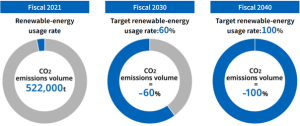
CO2 emission volume
In addition to previous energy-saving activities, based on each business division and each country, we are sequentially introducing renewable energy sources that are optimal at the time (switching to renewable energy sources, implementing solar power generation for in-house consumption, etc.). Emissions were reduced compared to the base year and CO2 emissions per unit of net sales were also on a decreasing (improving) trend due to the effects of energy conservation and the introduction of renewable energy, and changes in production volume due to a temporary decrease in customer demand in some businesses in FY23.
| K t-CO2e | Unit | FY2021 Base year |
FY2022 | FY2023 | FY2024 |
| Scope 1 | K t-CO2e | 16 | 13 | 11 | 17 |
| Scope 2 (Market basis) |
K t-CO2e | 506 | 486 | 392 | 387 |
| Total | K t-CO2e | 522 | 499 | 403 | 404 |
| CO2 emissions per unit of net sales | t-CO2 per billion yen |
789 | 689 | 529 | 466 |
| % of renewable energy electricity | % | 1.4% | 2.2% | 14.0% | 18.6% |
| Scope1+2 vs base year | % | – | – 4% | – 23% | -23% |
・Since FY2021, GHG emissions (Scope 1‧2, energy consumption) have been verified by a third party at a limited level of assurance.
・The figures for FY2021 were revised in February 2023 after reviewing the calculation method and CO2 emission factor in the verification process.
・From FY2024, lease vehicles at non-production sites, which are recognized as right-of-use assets for accounting purposes, are also included.
・For detailed Scope 1‧2 performance data, please refer to the ESG Data Book.
Energy saving and power saving activities
At production sites, we are replacing facilities with energy-saving types (such as adopting ice thermal storage systems and high-efficiency transformers), conducting energy-saving activities (such as optimizing the operating hours of boilers and air-conditioning equipment) and promoting roof-greening, etc. We are also endeavoring to suppress CO2 emissions from non-production bases by such means as introducing casual wear, adjusting the indoor temperature appropriately and implementing efficient lighting in offices.
Examples of energy/power saving initiatives
● Use of the Joint Crediting Mechanism (JCM)
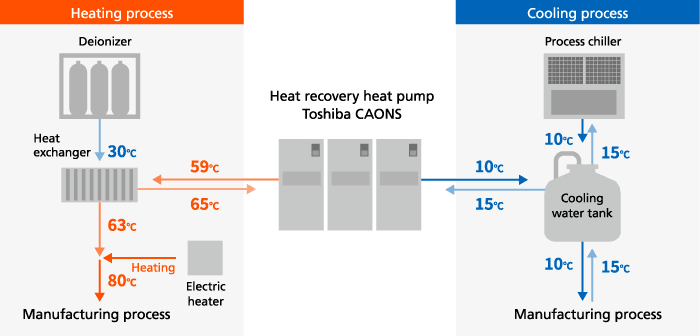
● In 2016, we introduced a heat recovery heat pump at the eyeglass lens site in Vietnam. It is used to save energy and reduce CO2 emissions by using the heat that used to be expelled to the outside air when cold heat was supplied as a source of cold heat for the production process and as an auxiliary heat source for heating the water used in the manufacturing process. Before introducing the heat recovery heat pump, we used only electric heaters to obtain the desired temperature.
● At the eyeglass lens site in Vietnam, one of the existing centrifugal chillers was replaced with a highly efficient inverter centrifugal chiller. By using the new chiller for regular operation and the old one as backup equipment, we achieved a lower introduction cost, improved energy efficiency, and reduced CO2 emissions at the same time.
Introduction of Renewable Energy
The HOYA Group is moving forward with switching to renewable energy at each production and sales site. In FY2023, the number of production sites with solar panels increased to four from one, and the Group is also accelerating conversion to purchase of renewable energy by reviewing electrical-power agreements and using energy attribute certificates, focusing on countries in which renewables are readily available. The Vision Care Division has achieved 100% renewable energy use at the Matsushima Plant and all other domestic production sites in Japan and several production sites in Europe (Hungary, Germany, and Italy). In addition, all Eye City contact lens stores (including offices) and HOYA Global Headquarters (Japan) have already achieved 100% renewable-energy usage, by means of non-fossil-fuel certificate from FIT. We will place more importance on the perspective of introducing additional renewable energy power and will actively promote initiatives to achieve the goal.
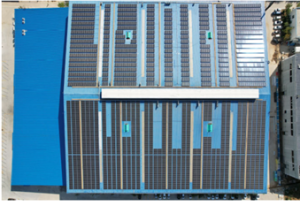
Solar panels installed at HOYA Optical Technology (Weihai) Co., Ltd., (Annual power generation: about 1,300 MWh, Annual CO2 reduction volume: about 800 t-CO2)
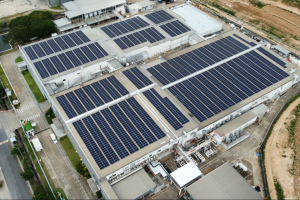
Solar panels installed at HOYA LAMPHUN LTD. (Annual power generation:about 2,200MWh, Annual CO2 reduction volume:about 1,000t-CO2)