Materiality
Process for Identifying and Assessing Material Impacts, Risks and Opportunities Related to Sustainability
In 2021, the HOYA Group identified four material issues that contribute to the enhancement of medium- to long-term corporate value: Greenhouse Gas Emissions Reduction, Employee Engagement and Diversity & Inclusion, Product Quality and Safety, and Supply Chain Management.
Since then, in response to changes in the external environment and increasing expectations regarding sustainability, we have systematically reviewed our material issues from a double materiality perspective and identified and assessed Impacts, Risks and Opportunities (IROs) from both:
・the impact of our business activities on the environment and society (Impact Materiality), and
・the impact of environmental and social issues on our business and financial performance (Financial Materiality)
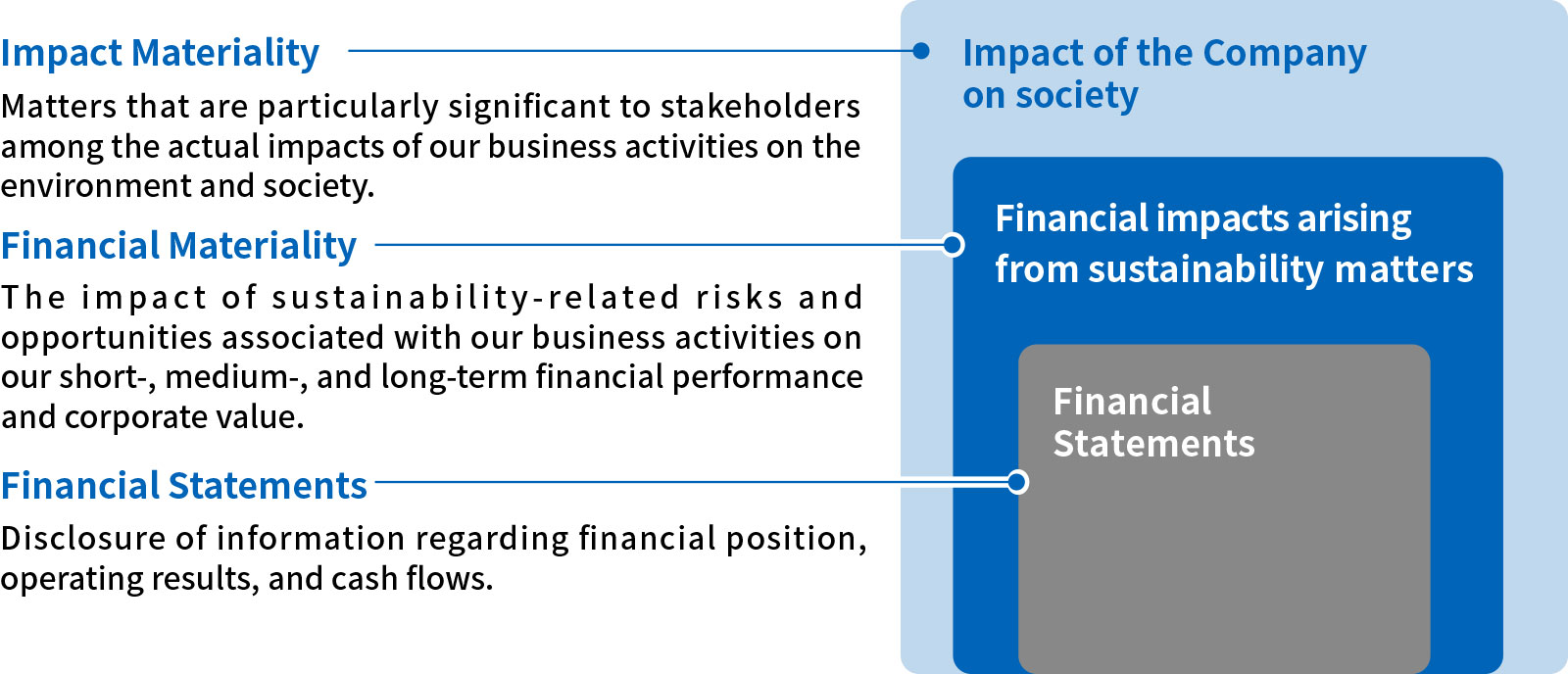
This assessment aims to align sustainability issues with business strategies, identify medium- to long-term risks and opportunities, and reflect them in management initiatives.
In addition, with future regulatory requirements such as the Corporate Sustainability Reporting Directive (CSRD) in Europe and standards being developed by the Sustainability Standards Board of Japan (SSBJ) in mind, we are enhancing accountability to stakeholders and improving the quality of our sustainability disclosures.
The assessment process consists of the following steps:
・Mapping the value chain
・Identifying material sustainability topics
・Identifying and assessing IROs
・Incorporating stakeholder perspectives
・Determining and approving material issues
Value Chain Mapping
Taking into account the characteristics of each business, we used the ENCORE framework to identify dependencies and impacts on natural capital. Based on this analysis, we mapped our value chain from upstream to downstream activities and identified key stakeholders associated with each stage.
Identification of Materiality Topics
Based on sustainability topics defined under the European Sustainability Reporting Standards (ESRS), we reviewed external frameworks such as GRI and SASB, perspectives from ESG rating agencies, disclosures by industry peers, and consistency with our existing disclosures and material issues. Through this process, we identified relevant sustainability topics and associated Impacts, Risks and Opportunities (IROs).
Assessment of IROs
Identified IROs are assessed from both impact and financial perspectives.
Impacts are evaluated based on:
・Scale
・Scope
・Remediability
・Likelihood
Risks and opportunities are evaluated based on:
・Magnitude of financial impact
・Likelihood
Scores are assigned according to predefined assessment criteria.
As we are still in the process of enhancing our assessment methodology and internal management processes, disclosure of detailed IROs and assessment results remains limited at this stage. Going forward, we will progressively enhance related disclosures.
Incorporating Stakeholder Perspectives
We conduct interviews with business divisions to verify consistency with operational realities and refine assessment outcomes. In addition to discussions with internal functions, we incorporate external perspectives through engagement with institutional investors and validate the appropriateness of assessment results.
The final assessment results are reported by the Chief Sustainability Officer (CSO) to the Board of Directors and, following Board review and approval, are utilized in business strategy, risk management, and future disclosures. This assessment is reviewed annually in principle and will continue to be enhanced in response to changes in the business environment and regulatory developments
Identified Material Issues
Identified Material |
Material |
Impacts, Risks |
Examples of Initiatives |
Relationship to |
Related Article |
|---|---|---|---|---|---|
Response to |
Climate Change Adaptation (Physical Risks) |
• Impact of increasingly severe and frequent extreme weather events on manufacturing and logistics operations (Risk) |
• Diversification of production sites and enhancement of BCPs (including responses to flood risks and other natural disasters) • Water-related risk assessments and monitoring |
None |
|
Climate Change Mitigation (Transition Risks) |
• Improved waste segregation and expansion of recycling channels to reduce waste and increase recycling rates • Increase in GHG emissions costs resulting from the introduction of carbon taxes and carbon pricing mechanisms (Risk) • Improved resource efficiency through packaging redesign and reuse of transportation containers |
• Expansion of renewable energy utilization • Participation in RE100 (100% renewable electricity target by 2040) • Preparation for SBT certification • Promotion of energy efficiency through replacement with high-efficiency production equipment |
Greenhouse Gas Emissions Reduction |
||
Water Resources |
Reduction and Efficient Use of Water Withdrawal |
• Impact on water resources through water withdrawal in manufacturing processes (-) |
• Reduction and optimization of water consumption through production process improvements • Promotion of higher water recycling rates • Water stress risk assessments and monitoring |
None |
|
Circular Resources |
Waste Reduction and Recycling Promotion |
• Environmental burden associated with treatment and disposal of waste generated during manufacturing processes (-) |
• Improved waste segregation and expansion of recycling channels to reduce waste and increase recycling rates • Improved resource efficiency through packaging redesign and reuse of transportation containers |
None |
|
Human Capital |
Stable Acquisition of Talent / Diversity & Inclusion |
• Contribution to employees' livelihoods through employment creation (+) • Provision of equitable opportunities through an inclusive workplace where diverse talent can thrive (+) • Impact on business operations resulting from a more challenging talent acquisition environment (Risk) • Innovation creation and enhanced competitiveness through the contribution of diverse talent (Opportunity) |
• Establishment of global talent evaluation systems and workplace environments that support diverse employees • Promotion of gender diversity initiatives, particularly in Japan • Expansion of leadership opportunities for local talent outside Japan • Development of employee-friendly workplace environments and systems |
Employee Engagement |
|
Talent Development and Capability Building |
• Contribution to employee knowledge and skills development through education and training opportunities (+) • Improved productivity, innovation, and competitiveness through enhanced employee capabilities (Opportunity) |
• Ongoing talent development and capability enhancement through online learning, career support programs, and performance evaluation systems |
|||
Occupational Safety and Health |
• Impact on employee safety and health arising from business activities (+/-) • Improved employee wellbeing and productivity through a safe and healthy work environment (Opportunity) |
• Establishment of a global occupational safety and health management system based on ISO 45001 • Implementation of various health and wellbeing initiatives |
None |
||
Human Rights |
Respect for Human Rights / Compliance-Oriented Workplace Culture |
• Negative impacts on employees and workers resulting from human rights violations within business activities or supply chains (-) |
• Internal risk assessments based on the Human Rights Policy and Human Rights Due Diligence Policy • Monitoring of human rights risks through supplier assessments • Maintenance of reporting and consultation channels through the HOYA Helpline and implementation of related education and training |
Supply Chain Management |
|
Product |
Product Safety and Quality (Primarily Life Care Business) |
• Impact on customers and patients arising from product quality or safety issues (-) |
• Continuous enhancement of quality management and product risk management systems • Strengthening governance through the Healthcare Compliance Committee |
Product Quality and Safety |
|
Ethics and |
Business Ethics and Corporate Culture |
• Impact on stakeholders arising from misconduct or compliance violations (-) |
• Strengthening awareness through communication and training regarding the HOYA Standards of Conduct |
None |
|
Prevention of Corruption and Bribery |
• Impact on stakeholders arising from corruption, bribery, or other forms of misconduct (-) |
• Reinforcement of the Standards of Conduct and compliance education programs |
None |
||
Privacy Protection |
Management of Personal Information |
• Impact on customers, employees, and other stakeholders arising from personal data breaches or inappropriate handling of personal information (-) |
• Strengthening governance, coordination with information security functions, risk monitoring, and internal controls to ensure robust protection of personal information |
None |