Climate Change
Response to Climate Change
The HOYA Group has identified climate change as one of its material issues and is committed to reducing greenhouse gas (GHG) emissions while enhancing business resilience. In 2023, we began disclosures aligned with the recommendations of the Task Force on Climate-related Financial Disclosures (TCFD) and joined RE100, establishing a target of sourcing 100% of our electricity from renewable energy by FY2040. Through these initiatives, we are accelerating both our response to climate change and our decarbonization efforts.
Medium- to Long-term Targets and Results for Greenhouse Gas Emissions Reduction
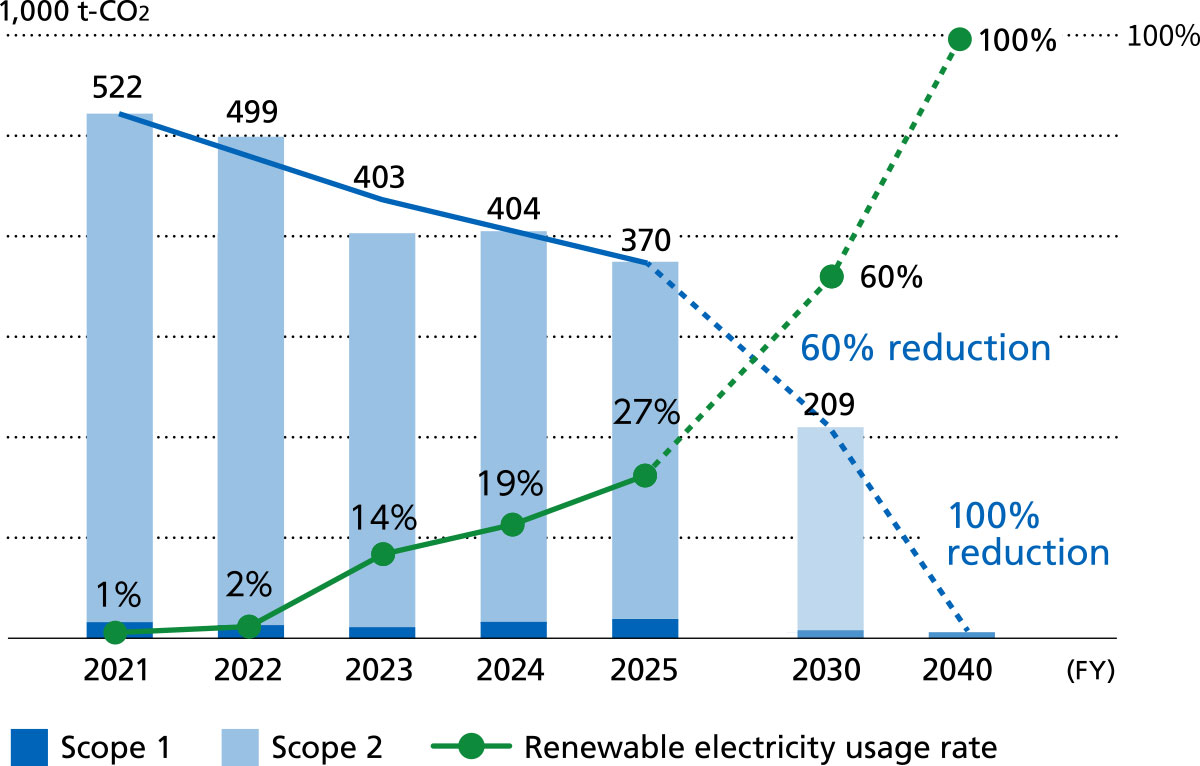
More than 90% of the HOYA Group's Scope 1 and Scope 2 emissions consist of Scope 2 emissions associated with purchased electricity. As a result, transitioning to renewable electricity represents one of our most important emissions reduction initiatives.
The Group has established a target of sourcing 100% of its electricity from renewable energy by FY2040, with an interim target of achieving a renewable electricity usage rate of 60% by FY2030.
In addition, through emissions reduction initiatives including the expansion of renewable energy procurement, we aim to reduce Scope 1 and Scope 2 emissions by 60% by FY2030 and by 100% by FY2040, compared with the FY2021 baseline.
To achieve these targets, each business division has developed a medium- to long-term roadmap covering renewable energy adoption and CO₂ emissions reduction and is implementing specific initiatives to achieve its targets.
CO₂ Emissions and Renewable Electricity Usage Rate
Since FY2021, greenhouse gas emissions (Scope 1 and Scope 2, energy consumption) have been verified by a third party through limited-assurance operations. In the course of the verification process, the method of calculation and coefficient used to calculate CO₂ were revised, resulting in correction of the figures disclosed in February 2023.
The Group is considering offsets using carbon credits for the residual emissions after maximum reduction efforts are made for Scope 1.
In FY2025, Scope 1 emissions totaled 23 thousand t-CO₂, while Scope 2 emissions (market-based) totaled 347 thousand t-CO₂, resulting in total Scope 1 and Scope 2 emissions of 370 thousand t-CO₂.* This represents a reduction of approximately 29% compared with the base year (FY2021).
Despite increased production volumes across our businesses, the continued expansion of renewable electricity and implementation of energy-efficiency initiatives contributed to a 16% improvement in emissions intensity per consolidated revenue compared with the previous fiscal year. In addition, improvements were achieved in electricity consumption per unit of production, which is managed as an environmental KPI in our major businesses, contributing to enhanced energy efficiency.
Furthermore, the renewable electricity usage rate increased by eight percentage points from the previous fiscal year to 27%. By advancing both the adoption of renewable energy and energy-efficiency initiatives, we will continue working toward the realization of a decarbonized society while achieving both business growth and reduced environmental impact.
* Beginning in FY2025, Scope 1 emissions include non-energy-related greenhouse gas emissions. These emissions account for approximately 1% of total Scope 1 and Scope 2 emissions.
Expansion of Renewable Electricity Use
The HOYA Group continues to expand the use of renewable electricity across its manufacturing and sales sites. At manufacturing sites, we are steadily increasing the installation of solar power generation systems, including self-consumption and on-site PPA projects. In addition, we are promoting the transition to renewable electricity through optimization of electricity procurement contracts and the purchase of renewable energy certificates.
When introducing renewable energy, we evaluate applicable regulations, market conditions, and site-specific constraints to determine the most appropriate approach. In March 2026, we also entered into an off-site corporate PPA agreement for our Akishima site in Japan. Through these initiatives, we place particular emphasis on the additionality of renewable energy procurement.
Within the Vision Care business (eyeglass lenses), all domestic sites, including the Matsushima manufacturing site, as well as multiple overseas sites have achieved effective 100% renewable electricity usage.
In addition, all stores and offices of Eyecity, our specialty contact lens retail business, together with HOYA Global Headquarters in Japan, have achieved effective 100% renewable electricity usage through the procurement of FIT Non-Fossil Certificates.
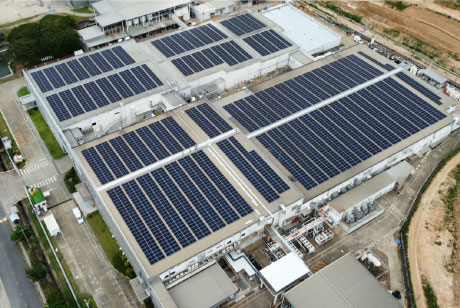
Solar panels installed at HOYA LAMPHUN LTD. (Annual generating capacity: about 2,200 MWh; Annual CO2 reduction volume: about 1,000 t-CO₂)
Initiatives to Raise Energy Efficiency
In addition to expanding the use of renewable energy, we are pursuing initiatives to improve energy efficiency at manufacturing sites as part of our efforts to reduce GHG emissions. These initiatives include replacing existing equipment with high-efficiency alternatives and optimizing operating conditions for facilities such as boilers and air-conditioning systems to reduce overall energy consumption.
Because electricity represents the primary source of energy consumption at many of our manufacturing sites, we are visualizing electricity consumption at the equipment level. This enables us to identify energy losses and prioritize energy-saving measures and equipment upgrades.
Energy-Efficiency Targets
Each business division establishes energy conservation targets based on its business characteristics, using energy intensity as a key environmental KPI. To support these targets, business divisions continue to introduce energy-efficient equipment and improve manufacturing processes. For sites in Japan, the Group has established a common target of improving energy intensity by more than 1% annually on average over the five-year period from FY2022 through FY2026, in line with the principles of Japan's Energy Conservation Act. Business divisions monitor progress and manage performance in accordance with this policy.
Capital Investments Based on Medium- to Long-term Roadmaps
To ensure the steady implementation of these initiatives, each business division develops and annually reviews capital investment plans for renewable energy adoption and energy-efficiency measures with FY2030 targets in mind. Renewable energy targets and related investment plans are incorporated into the annual budgeting process and are implemented following approval by the Board of Directors, supporting decarbonization efforts across the Group.
Developing Investment Plans Through Visualization of Equipment-Level Electricity Efficiency
At our contact lens and intraocular lens manufacturing site in Thailand, electricity consumption was measured and analyzed over a one-month period for all major power-consuming equipment.
By visualizing energy efficiency at the equipment level and benchmarking performance against the latest technologies, the site was able to develop investment plans based on objective analysis of energy-saving opportunities.Energy Savings Through the Introduction of High-Efficiency Equipment
At several eyeglass lens manufacturing sites, hydraulic injection molding machines were replaced with electric models, resulting in lower energy consumption and reduced CO₂ emissions.
At another site, an air-cooled chiller, which represented a significant share of total electricity consumption, was replaced with a high-efficiency magnetic water-cooled chiller. This initiative reduced CO₂ emissions by approximately 40%.
Through these and similar initiatives, sites continue to prioritize investments based on energy-efficiency assessments and pursue ongoing reductions in energy consumption.
Initiatives to Measure and Reduce CO₂ Emissions Across the Entire Value Chain
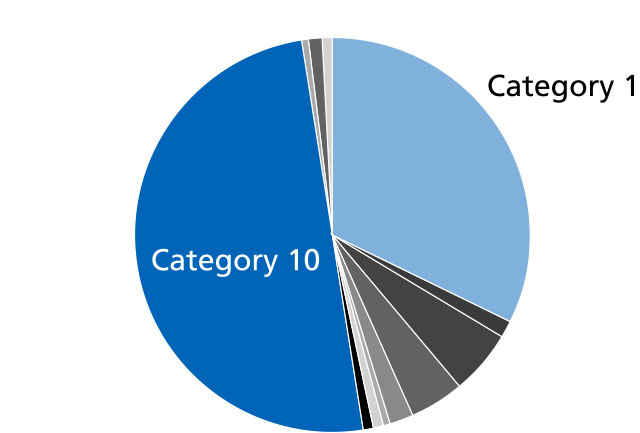
As a manufacturing-focused company, HOYA procures a significant amount of raw materials and components. As a result, emissions generated during suppliers' manufacturing processes (Scope 3 Category 1: Purchased Goods and Services) represent one of the Group's most significant sources of emissions. In addition, many HOYA products serve as intermediate materials that undergo further processing by customers. Consequently, emissions associated with downstream processing by customers (Scope 3 Category 10: Processing of Sold Products) also account for a substantial portion of our Scope 3 emissions.
To reduce Scope 3 emissions, we are improving both the efficiency and accuracy of data collection while strengthening engagement with suppliers and customers to promote emissions reductions across the value chain. We are also pursuing certification under the Science Based Targets initiative (SBTi) to further align our emissions reduction efforts with internationally recognized climate goals.
Scope-specific |
FY2025 Results |
Ratio |
|
|---|---|---|---|
★Scope1 |
23 |
1% |
|
★Scope2 |
Location-basis |
460 |
– |
Scope 3 |
Total |
2,005 |
84% |
★Category 1 |
651 |
33% |
|
Category 2 |
27 |
1% |
|
Category 3 |
105 |
5% |
|
Category 4 |
90 |
4% |
|
Category 5 |
39 |
2% |
|
Category 6 |
12 |
1% |
|
Category 7 |
15 |
1% |
|
Category 8 |
0 |
– |
|
Category 9 |
17 |
1% |
|
★Category 10 |
1,001 |
50% |
|
Category 11 |
14 |
1% |
|
Category 12 |
18 |
1% |
|
Category 13 |
0 |
– |
|
Category 14 |
0 |
– |
|
Category 15 |
16 |
1% |
|
GHG Emissions |
Total |
2,375 |
100% |
★Data assured by an independent third party
Emissions by Scope
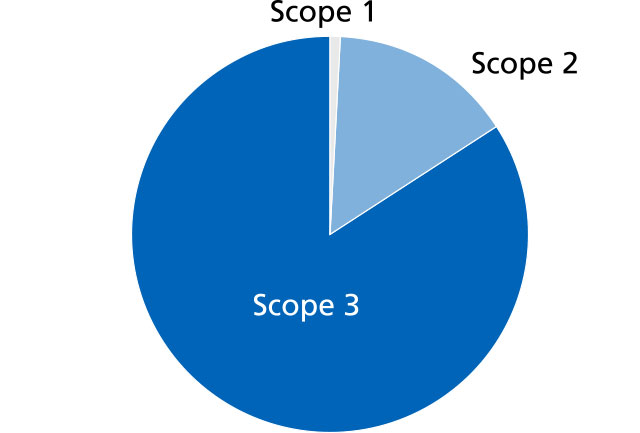
Emissions by Scope 3 Category
Scope-specific |
Emissions Reduction Initiatives |
|
|---|---|---|
Scope 1 |
・Replacement with energy-efficient equipment ・Optimization of boiler and air-conditioning operations ・Evaluation of electrification opportunities |
|
Scope 2 |
・Replacement with energy-efficient equipment ・Expanded procurement of renewable energy ・Optimization of energy usage |
|
Scope 3 |
Category 1: |
・Collaboration with suppliers to improve emissions visibility ・Promotion of energy-efficiency measures and renewable energy adoption throughout the supply chain |
Category 3: |
・Promotion of energy conservation activities ・Expansion of renewable energy use closely linked to Scope 1 and Scope 2 reduction initiatives |
|
Category 4: |
・Optimization of transportation routes and shipping frequency ・Modal shift from air freight to ocean freight ・Improved transportation efficiency through packaging size and weight reductions |
|
Category 5: |
・Promotion of recycling and landfill avoidance for manufacturing waste materials |
|
Category 10: |
・Collaboration with customers to support the decarbonization of downstream processing |
|
Category 12: |
・Reduction of packaging materials ・Reduction of single-use plastics |
|
Scenario Analysis Based on the TCFD Recommendations
From FY2022, the HOYA Group began scenario analysis based on the TCFD recommendations. In the first year, the Group focused on two business divisions, eyeglass lenses and glass substrates for HDDs, with high CO₂ emissions (high power consumption). We conducted analysis using 4°C and 1.5°C scenarios with a time horizon of FY2030, targeting factories in Thailand and Vietnam, which are the main production sites for these divisions. In FY2023, the scope of scenario analysis was widened to include the Optics Division (optical lenses). The combined CO₂ emissions of these three business divisions account for approximately 88% of the HOYA Group's total CO₂ emissions. We also conducted a risk assessment of all our production sites with respect to physical risk (flooding), which we have positioned as a key climate change risk.
The HOYA Group will continue to conduct regular reviews in response to changes in the external environment, reflecting the results of scenario analysis in its business activities and strengthen responses to risks and opportunities and thus build resilience to climate change.
Examples of risks and opportunities in the eyeglass lenses business division
Description |
Response |
|
|---|---|---|
Transition risks |
・Delays in responding to consumers’ heightened awareness of climate change results in lost market share and/or declining sales. ・Action on climate change and climate-related disclosure have been added to factors customers use to select suppliers. Delay in responding results in lost customers and/or declining sales. ・Inadequate response to environmental issues such as reduction of CO₂ emissions and water recycling causes loss of reputation and/or declining sales. |
・Consideration of listing CO₂ emissions on product packaging ・Revision of marketing strategy: Reduction of impact from climate change through product innovation; enhanced dissemination of information ・Regular reporting to customers and other external stakeholders regarding progress on ESG ・Expansion of disclosure related to climate change, such as TCFD or CDP |
Physical risks |
Infectious-disease outbreaks made possible by unusual weather disrupt production activities and supply chains or trigger lockdowns and other restrictions on activity, causing the optometrist shops that are the Group’s customers to restrict hours of operation, thereby reducing demand. |
・Drafting and updating of BCPs for Group plants ・Geographical diversification of production sites |
Unusual weather causes stagnation in production or sales activities; flooding causes inundation or destruction of production sites. |
・Geographical diversification of production sites and advancement of measures against water damage ・Drafting of BCPs to secure/safeguard materials, inventories, etc. |
|
Opportunities |
As demand for low-carbon products grows, early success in product development leads to increased sales. |
・Listing of carbon footprints ・Incorporation of determination to reduce environmental impact into product development strategy ・Coordination with material producers |
As demand grows for products that are easy to recycle/reuse, early success in product development leads to increased sales. |
・Formation of a product strategy focused on a recycling-oriented society through collaboration with suppliers and customers |
|
The Group streamlines production processes using DX, etc. |
・Reduction of CO₂ emissions and related costs by improving production efficiency ・Investment in DX and DX training |
|
Drafting of BCPs, use of in-house production sites and diversification of suppliers |
・Introduction of and training in BCPs ・Refurbishment of each plant, geographical diversification of production sites, etc. |
Examples of risks and opportunities in the glass substrate for HDDs business division
Description |
Response |
|
|---|---|---|
Physical risks |
Infectious-disease outbreaks made possible by unusual weather disrupt production activities and supply chains, causing customers’ plants to reduce levels of operation, thereby reducing demand. |
・Drafting and updating of BCPs for in-house production sites ・Geographical diversification of production sites ・Consideration of plans to reduce customers’ climate-change risk |
Opportunities |
Disclosures on ESG, climate change, etc., boost the Company’s reputation on financial markets, reducing cost of fundraising. |
・Deployment in disclosures for TCFD and on ESG ・Disclosure and improvement of rank on CDP |
As demand for low-carbon products grows, early success in product development leads to increased sales. |
・Listing of carbon footprints ・Revision of product strategies ・Increase in budget for technology development ・Coordination with material producers |
|
As global warming causes water shortages, successful development of technologies to reuse and reduce water use leads to reduced water costs. |
・Establishment of production methods that use little water ・Introduction of advanced water treatment technologies, increase in reuse |
|
Technologies such as DX achieve improved efficiency in manufacturing processes. |
・Reduction of CO₂ emissions and reduction of related costs due to improved production efficiency ・Investment in DX and DX training |
|
Drafting of BCPs, use of in-house production sites and diversification of suppliers |
・Introduction of and training in BCPs ・Refurbishment of each plant, geographical diversification of production sites, etc. |
Examples of risks and opportunities in the optics business division (optical glass)
Description |
Response |
|
|---|---|---|
Physical risks |
Delays in deliveries and reduced production volume due to stoppages of operations at raw material suppliers caused by extreme weather and natural disasters |
Securing inventory (especially for critical materials for which procurement sources are limited) |
Securing multiple suppliers for critical materials |
||
Production activities and supply chain disruptions caused by outbreaks of infectious diseases triggered by extreme weather conditions, and a decline in demand due to a downturn in the operation of factories by customers |
Formulation/update of BCP for our factories |
|
Establishment of production backup systems at other sites |
||
Stagnation of production and sales activities due to extreme weather conditions, and the submersion or destruction of production sites due to flooding |
Promote production backup systems at other sites and measures against flood at each site |
|
Formulate BCP including securing materials and inventory |
Climate-related Risk Management
The HOYA Group continuously monitors developments in the external environment and regulatory landscape relating to climate change. When significant changes occur, climate-related risks are reassessed accordingly.
Physical risks associated with climate change are evaluated through collaboration between relevant corporate functions, including the ESG Promotion Office, and business divisions. Based on these assessments, business leaders work with manufacturing, procurement, retail development, and other relevant functions to develop and implement appropriate mitigation measures.
Transition risks arising from changes in the business environment are addressed by sharing climate scenario analysis results with Sustainability/ESG representatives in each business division, as well as with functions such as environment, quality assurance, and procurement. Appropriate response measures are then developed and implemented according to the characteristics of each business.
The Group also utilizes an Internal Carbon Price (ICP) when assessing the potential financial impact of future carbon taxes, emissions trading schemes, and other carbon-pricing mechanisms, as well as when evaluating investments in renewable energy and energy-efficiency initiatives.
The ICP is based on carbon pricing scenarios published in the International Energy Agency (IEA)'s World Energy Outlook (WEO) and is used in the assessment of climate-related risks and the evaluation of potential response measures.
Water Risk Assessment
An increase in the frequency and severity of natural disasters associated with climate change, as well as water scarcity, may affect not only the operations of our own facilities but also activities across our value chain, including raw material procurement and customers' manufacturing and sales operations. The HOYA Group assesses flood risk and water stress risk at production sites by using such tools as the Aqueduct Water Risk Atlas tool developed by the World Resources Institute (WRI), an international environmental NGO, and by conducting interviews at production sites.
In order to conduct efficient corporate operations from a global perspective, we promote management decision-making, R&D, production, and sales in optimal locations. In particular, our production sites are primarily located in Southeast Asia. The results of the risk assessment showed that the flood risk was relatively high for production sites in Southeast Asia, including Vietnam, Thailand, and Indonesia. Sites identified as high risk collaborate with the Environment, Health and Safety Department at the head office to formulate countermeasures and implement them as priorities.
› Water Stress Risk
Water Risk Measures
For high-risk sites, the Environment, Health and Safety Department at the head office conducts on-site visits to assess the effectiveness of measures addressing water-related risks, including flooding, water stress, and effluent and water pollution. Specific actions include reviewing and updating initial response protocols and recovery plans under the business continuity plan (BCP), implementing flood mitigation measures such as elevating equipment, and preparing for potential water shortages. Drawing on lessons learned from the flood damage at our production site in Thailand in 2011, we actively promote the development and regular review of BCPs, as well as the establishment of systems and training programs to ensure employee safety. Furthermore, we continue to mitigate water risks through a multifaceted approach, including diversifying production to sites with lower flood risk and maintaining appropriate inventory levels to prepare for potential supply chain disruptions.
Carbon Offset
Since August 2022, the HOYA Group has been participating in the JAL Carbon Offset program. Under this initiative, the Group offsets the CO₂ emitted on business travel flights to or from Japan on JAL by purchasing carbon credits from the Southern Cardamom and Amazon Rainforest Conservation Projects.* These projects are considered highly important not only for their CO₂ absorption benefits through forest preservation, but also for their contributions to wildlife protection, ecosystem conservation, and support for the livelihoods of local communities. We support these projects through the purchase of carbon credits. In FY2025, the Group purchased credits equivalent to some 198 tons of CO₂, which offset approximately 258 tons.
(Note: Reported GHG emissions do not reflect the emissions reduction effects of carbon credits.)
* This carbon project is verified through the Verified Carbon Standard (VCS).