ESG and Sustainability
Governance Framework
Governance
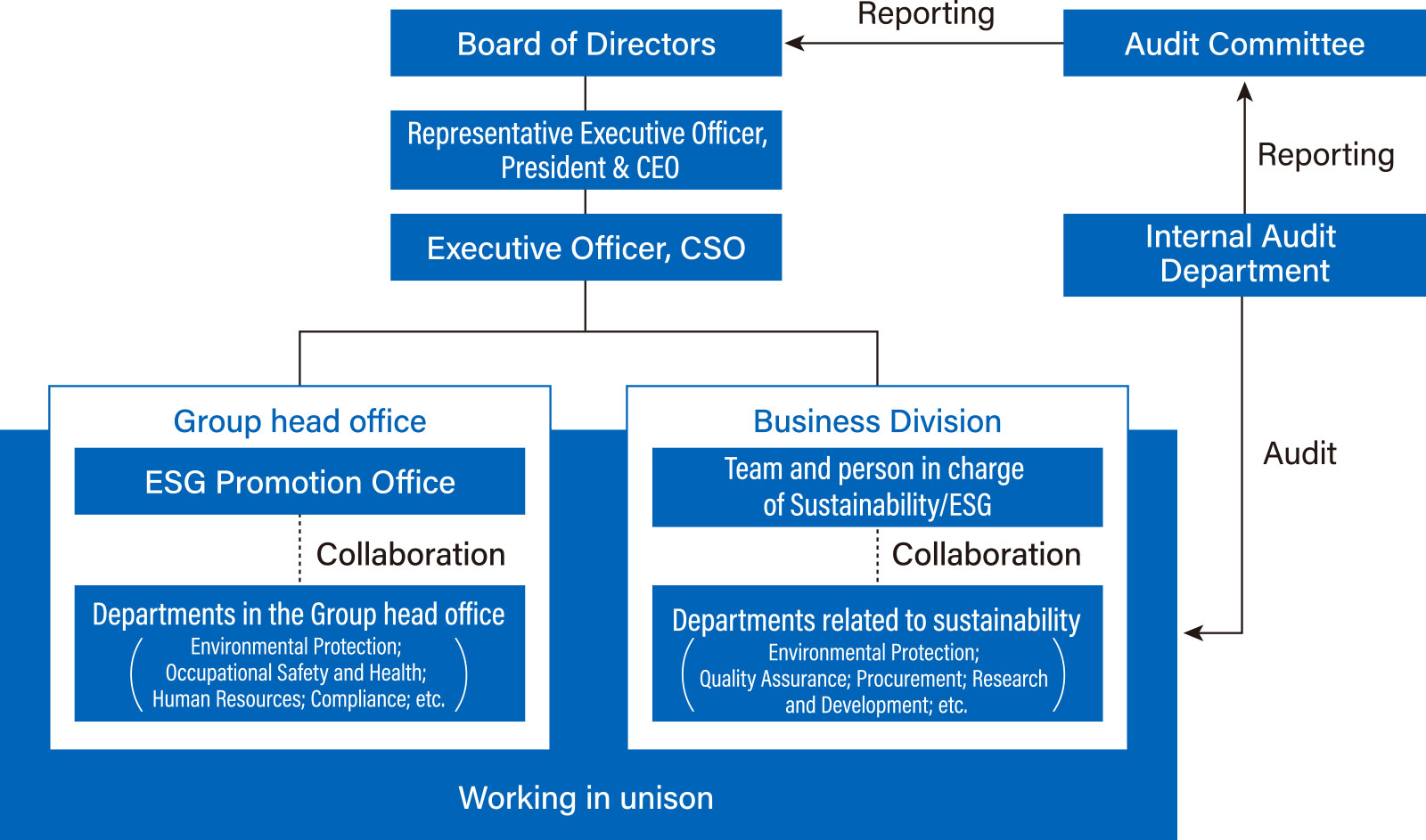
The Company has adopted a Company with Nomination Committee, etc. structure, under which the Board of Directors functions as a monitoring board, supervising the executive side while deliberating and making decisions on important matters concerning the Group's management policies.
In FY2025, five of the Company's seven directors were Independent Directors, ensuring objective oversight and effective supervisory functions. The Company appoints Independent Directors who possess extensive executive experience and a global perspective, as well as expertise and experience in sustainability and ESG-related fields, including climate change, human capital development, and leadership development.
The Group's basic sustainability policies, materiality, and key initiatives such as TCFD disclosures and RE100 commitments are disclosed following deliberation and approval by the Board of Directors. The Board of Directors also receives regular reports from the Chief Sustainability Officer (CSO) regarding sustainability-related issues, including climate change, and the Group's initiatives in these areas (twice during FY2025), and monitors progress accordingly. In addition, through the review of individual business divisions at Board meetings, the Board receives reports on sustainability-related issues within each business and provides advice from multiple perspectives.
The Company operates under a divisional management structure based on portfolio management. Sustainability-related initiatives within each business division are incorporated into the division's management strategy, business plan, and annual budget, all of which are approved by the Board of Directors.
Each business division appoints a dedicated sustainability/ESG team under the leadership of the division head. Working closely with the CSO, these teams establish KPIs aligned with Group-wide objectives and implement initiatives to achieve them.
To further strengthen accountability, ESG indicators have also been incorporated into management incentives. Since FY2022, ESG indicators have been included in the medium- to long-term incentive plan for Executive Officers through the Performance Share Unit (PSU) program. Furthermore, since FY2023, key ESG-related KPIs, such as the renewable energy usage rate, have also been incorporated into the annual incentive evaluation framework for business division heads.
Risk Management
The Company has established a risk management framework under which responsible officers are appointed both at Group headquarters and within individual business divisions for key sustainability-related risk areas, including environmental management, occupational safety and health, product quality and safety, compliance, privacy, and human capital.
The responsible officers at Group headquarters regularly monitor the activities of the business divisions within their respective areas of responsibility and report significant risks and the status of mitigation efforts to the Executive Officers.
Sustainability-related risks within each business division are managed by the division itself, taking into account its specific business characteristics and operating environment. Each division develops appropriate response policies and incorporates preventive and risk mitigation measures into its business strategies and plans.
The Board of Directors has ultimate oversight responsibility for significant Group-wide risks and the overall risk management framework. The Board receives reports at least annually from the executive side, including Executive Officers, responsible officers at Group headquarters, and business division heads, regarding risk assessment results, response measures, improvement activities, and residual risks. The Board reviews and deliberates on these matters and regularly monitors both the effectiveness of sustainability-related risk responses and the overall risk management framework.
The Internal Audit Department conducts risk-based audits to evaluate the effectiveness of sustainability-related risk management implemented by the executive organization. For example, the Group Regulatory, Quality and Government Affairs function oversees the establishment and operation of quality management systems across the Life Care businesses. The Internal Audit Department conducts annual audits of these systems, evaluates their effectiveness, and promotes improvements where necessary. Through these efforts, the Company seeks to appropriately prevent and mitigate significant sustainability-related risks, including quality-related risks associated with healthcare products.
Audit results are reported to the Audit Committee. The Audit Committee independently monitors the effectiveness of the risk management framework through reviews of internal audit findings and progress on corrective actions, and requests improvements from management where appropriate.
The results of the Audit Committee's oversight activities are also reported to the Board of Directors and utilized in the Board's supervision of the Group's risk management framework.
For more information regarding the Group's enterprise-wide risk management activities, please refer to "Risk Management."
Sustainability/ESG Organizational Structure
Sustainability Policy
For the purpose of clearly stipulating the HOYA Group’s basic stance and policy on sustainability and further promoting sustainability activities, we established the HOYA Group’s Sustainability Policy in May 2022.
HOYA Group is committed to contribute towards building a sustainable society and aims to enhance our long-term corporate value by implementing our management principles based on our corporate mission in our day-to-day work.
We will aim to help resolve global social issues through innovation in our businesses.
We will realize fair and highly transparent corporate management by building a relationship based on trust through consistent dialogue with key stakeholders.
We will aim to minimize environmental externalities in our business activities to ensure our future generations inherit a healthy global environment in future.
We respect the human rights of all people involved in our business activities, including those in our supply chain and will strive to prevent any abuse on human rights.
We will create a work environment to promote diversity and inclusion with an emphasis on the wellbeing of our employees in the aim of keeping high motivation and moral to create new value.