Biodiversity
Nature-related Disclosures Based on the TNFD Recommendations
In accordance with the HOYA Group Sustainability Policy, we are committed to reducing environmental impacts arising from our business activities.
Recognizing the growing importance of understanding and managing both dependencies and impacts on natural capital, we have strengthened our approach to nature-related risks and opportunities. These efforts are integrated into our existing environmental risk management processes and managed within a Group-wide framework.
To systematically advance our understanding of natural capital, we initiated assessments based on the TNFD (Taskforce on Nature-related Financial Disclosures) LEAP approach in FY2025.
As a first step, we assessed our manufacturing sites using the Locate and Evaluate phases of the LEAP approach. This initial assessment was designed to identify key interfaces with nature and to better understand material dependencies and impacts on natural capital. The assessment adopted a region-specific approach reflecting the geographic characteristics of each site and evaluated both dependencies on and impacts to natural capital.
Going forward, we will expand the scope of assessments and deepen our analysis to strengthen our understanding of nature-related risks and opportunities. Based on the results, we will continue evaluating approaches to risk management and enhancing nature-related disclosures.
Assessment Process Based on the LEAP Approach

Locate
We conducted environmental risk assessments for approximately 60 manufacturing sites using external databases covering water stress, biodiversity, and proximity to protected areas. While relatively high water stress was identified at certain overseas sites, exposure to water-related risks was not found to be concentrated at a level that would result in significant impacts at present. In addition, no direct overlap was identified between our sites and biodiversity-important areas or legally protected areas, leading us to conclude that impacts associated with land use are currently limited. We will continue strengthening environmental risk management through ongoing monitoring and more advanced analysis.
Data Category |
Database |
|---|---|
Water Stress |
Aqueduct Water Risk Atlas tool |
Biodiversity |
IBAT (Integrated Biodiversity Assessment Tool) |
Protected Areas |
Protected Planet |
Evaluate
Using ENCORE, a tool that evaluates business dependencies and impacts on natural capital, we assessed the materiality of natural capital dependencies and impacts across the Group's businesses.
From a dependency perspective, certain businesses within the Life Care segment were found to have relatively high dependence on water-related ecosystem services, including:
・Water purification
・Water supply
・Water flow regulation
・Flood mitigation
Although most Life Care businesses other than Eyeglass Lenses have relatively limited dependence on water resources, some businesses within the Information Technology segment consume substantial amounts of water. As a result, we recognize effective water resource management as an important priority.
From an impact perspective, emissions to air, soil, and water were identified as key management issues across both the Life Care and Information Technology segments. In addition to ensuring compliance with environmental regulations, we will continue reducing environmental impacts while considering the potential effects of our operations on water resources and biodiversity.
Segments |
Business Units |
ISIC Group |
Dependencies |
|||||
|---|---|---|---|---|---|---|---|---|
Climate Regulation and Maintenance Services |
||||||||
Soil and Sediment Retention |
Water Purification |
Flood Mitigation Services |
Water Supply |
Storm and Wind Protection |
Water Flow Regulation |
|||
Life Care |
Eyeglass Lenses |
Medical Devices |
VH |
M |
H |
M |
H |
|
Medical Endoscopes |
Endoscopes |
M |
M |
M |
M |
M |
||
Contact Lenses |
Retail |
M |
M |
M |
M |
|||
Information Technology |
Glass Substrates for HDDs |
Magnetic Media |
M |
M |
M |
M |
M |
|
Semiconductor Mask Blanks and Photomasks |
Substrates |
M |
M |
M |
M |
M |
||
Optical Solutions |
Optical Equipment |
M |
M |
M |
M |
M |
||
Segments |
Business Units |
ISIC Group |
Impact Categories |
||||
|---|---|---|---|---|---|---|---|
Disturbance |
Climate Change |
Pollution |
Resource Extraction |
||||
Greenhouse gas (GHG) emissions |
Greenhouse gas (GHG) emissions |
Emissions of air pollutants other than |
Release of hazardous substances into soil and water |
Water consumption |
|||
Life Care |
Eyeglass Lenses |
Medical Devices |
M |
H |
M |
M |
|
Medical Endoscopes |
Endoscopes |
M |
M |
H |
M |
M |
|
Contact Lenses |
Retail |
M |
M |
||||
Information Technology |
Glass Substrates for HDDs |
Magnetic Media |
M |
M |
H |
M |
M |
Semiconductor Mask Blanks and Photomasks |
Substrates |
M |
H |
H |
|||
Optical Solutions |
Optical Equipment |
M |
M |
M |
M |
M |
|
Items below L (Low), including VL (Very Low), N/A (Not Applicable), and ND (No Data), are not shown.
M: Medium
H: High
VH: Very High
Key Findings from the Nature-related Assessment
Based on the results of the analysis, no material nature-related risks to the Group's businesses have been identified at this time.
However, the assessment confirmed that the Group maintains meaningful connections to natural capital through its dependence on water resources and through environmental impacts associated with business activities.
In particular, the following were identified as relatively significant topics from both dependency and impact perspectives:
・Climate change
・Water resources
・Waste management
These themes are consistent with the environmental priorities that the Group has managed for many years. We believe that our existing initiatives contribute not only to reducing environmental impacts but also to mitigating nature-related risks.
Going forward, we will continue advancing initiatives in these priority areas while further enhancing our analysis of both dependencies and impacts on natural capital. Through these efforts, we aim to strengthen our ability to identify potential risks and opportunities and respond appropriately.
Related Topics
› Climate Change › Water › Pollution Control Measures and Waste
Biodiversity-related Activities Across Business Divisions
Sites across the Group undertake biodiversity-related initiatives tailored to local conditions, including tree-planting programs, community clean-up activities, and participation in local environmental conservation initiatives.
Through these activities, we promote coexistence with nature while fostering greater environmental awareness among employees.
-
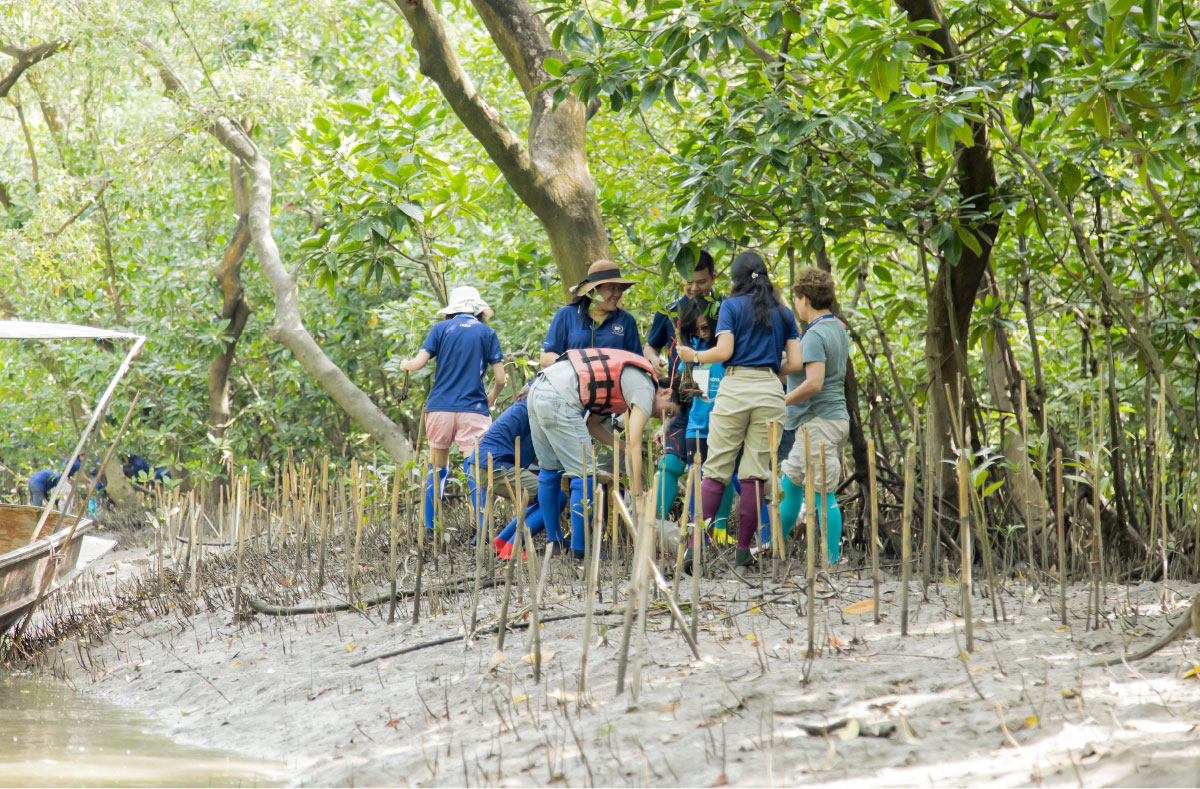
Biodiversity Conservation Through Mangrove Restoration in Thailand
As part of One Vision, HOYA Vision Care’s employee-led sustainability program, which empowers employees around the world to initiate and participate in activities that address environmental and social challenges, we promote biodiversity conservation and ecosystem restoration.
Since 2016, employees at our major manufacturing site in Thailand have participated in ongoing mangrove planting and forest restoration activities in partnership with local communities and government organizations.
In addition to mangrove and forest restoration, activities include installing “Crab Condos” to support marine habitats and planting food trees for wildlife.
To date, approximately 3,000 trees, including 2,100 mangroves, have been planted, along with 200 food trees and 40 Crab Condos. Around 500 employees have participated, contributing more than 3,800 volunteer hours. These activities not only contribute to biodiversity conservation but also help raise environmental awareness among employees and strengthen connections with local communities. The annual CO₂ absorption effect of these planting activities is estimated at approximately 70 tons.
Case Study Video: › Mangrove Afforestation by HOYA Vision Care in Thailand