CEO Interview
Why launch HOYA Incubation Laboratories (HILS), a new organization integrating HOYA’s internal technologies, now?
CEO Eiichiro Ikeda discusses the strategic rationale behind this move, in light of progress in organic growth, and the initiatives aimed at positioning HOYA for the next decade and beyond.
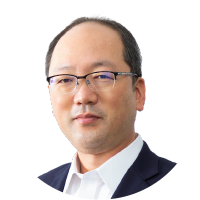
Eiichiro Ikeda
Director, Representative
Executive Officer,
President & CEO

Mr. Ikeda, rather than a formal interview this time, we would like to have a more casual conversation and ask for your candid thoughts on a range of topics.
Sounds good. Thank you.
Looking back on FY2025, how would you describe the year in a single phrase?
Conditions varied considerably across businesses, so it is difficult to sum up the year in a single phrase. If I had to, I would describe it as a year in which we reinforced the foundation for organic growth.
What specific progress was made?
We saw improved visibility in our core growth businesses, including customer acquisition in nearline HDD substrates and increased demand for EUV blanks driven by continued expansion of the AI market. As a result, we also approved major capacity expansion investments.
In Life Care as well, we reassessed our earnings structure and strengthened the foundation for stable earnings growth.
You have emphasized organic growth. Does that mean you do not plan to pursue M&A?
Since becoming CEO in 2022, I have explored M&A opportunities, but we have passed on them due to a lack of economic rationale. We will continue to monitor opportunities going forward, but over the medium term, M&A is not our top priority given the large-scale internal investments already underway.
Indeed, with around 50 billion yen for HDD substrates and approximately 42 billion yen for EUV mask blanks, the scale of internal investment alone is substantial. I believe this is the first time in HOYA’s history that investments of this size have coincided. Are there any concerns regarding funding?
None at all. Our cash generation is extremely strong. In fact, we have even announced a policy to reduce excess cash on our balance sheet.
You are referring to the recently announced update to capital policy?
Yes. We intend to optimize our cash position over roughly three years, primarily through share buybacks.
ROE is already high at 25%, so the idea is to further improve capital efficiency by slimming down the balance sheet.
We have talked about many positive developments, but are there any areas of concern? Geopolitical risks, particularly in the Middle East, have been rising recently.
Naturally, it is impossible to completely eliminate risks arising from external factors. The key is how effectively we minimize the impact when such events occur.
Is this essentially about diversifying risk through the business portfolio?
Exactly. By diversifying our exposure across industries, regions, and customers, we reduce the impact on the Company as a whole.
Even at the individual business level, we have a culture and mechanisms for protecting profitability through measures such as flexible control of fixed costs and passing on cost increases through pricing. By responding flexibly in this way whenever challenges arise, HOYA has never posted a loss since its listing.
Given how rapidly the business environment is changing, I get the sense that HOYA embraces quick decision-making and course correction in a positive way.
Let me shift gears a little. It seems that visibility for medium-term organic growth has improved, but what do you think about long-term growth opportunities?
Of course, we cannot sustain growth indefinitely through existing businesses alone. That is why we view business development with a 10- to 20-year horizon as one of our most important management priorities.
So, will M&A be a key driver there?
While acquiring new businesses through M&A remains one option, when I look back at HOYA’s growth trajectory, I believe there is significant value in combining resources that already exist within the Company.
What do you mean by that?
I believe that by bringing together technologies across different parts of HOYA—such as optical technologies and mass production capabilities—we can develop seeds for future growth drivers. With this in mind, we are launching HILS, a new organization, in FY2026.
So, is it essentially an R&D center?
The key is that while HILS will fulfill the role of an R&D center, its activities will extend all the way through commercialization. Organizations like this often end up treating research itself as the goal. Our focus, however, is to work in an integrated manner toward product realization—from establishing concrete mass production frameworks to developing proposals that help solve customer challenges.
Why launch an organization like this now?
For roughly the past 20 years, beginning in the late 2000s, we positioned M&A at the center of our growth strategy and stopped developing foundational technology seeds outside our existing businesses. However, as I mentioned earlier, it has been difficult to find M&A opportunities that meet our standards in terms of valuation and profitability. Against this backdrop, momentum has been building internally to work collaboratively in creating new technologies and businesses.
This is not something that will produce results in just two or three years. However, for HOYA to achieve sustainable growth, it is important to plant seeds for the future—and now is precisely the right time to do so, as visibility for the medium-term growth of our existing businesses has improved.
It is exciting to think about what kinds of businesses may emerge. Thank you very much for your time today.