HOYA as an
Investment
—Building Long-Term Value, Quietly but Consistently—
HOYA has consistently delivered high capital efficiency over the long term, not by chasing short-term trends or competing on scale, but through its proprietary technologies and disciplined management.
The reason HOYA has earned the long-term trust of investors lies not in any single product or temporary growth opportunity, but in a set of enduring strengths that can be replicated consistently over time. These strengths can be attributed to three key sources:
Source of Strength 1
Financial Discipline and Culture Embedded in HOYA’s DNA
The foundation of HOYA’s strength lies in the fact that its strong commitment to profit margins and capital efficiency is embedded throughout the organization, rather than being confined to senior management.
In the retail sector, individual stores are generally held accountable only for sales. At Eyecity, HOYA’s contact lens retail business, however, a profit and loss statement is prepared for each store, and every store manager is personally accountable for its P&L. Even at the smallest operating unit—the individual store—the very structure that encourages frontline employees to make decisions based on profit rather than sales embodies HOYA’s culture.
HOYA also avoids holding surplus fixed assets wherever possible. Rather than seeking prestige through ownership of impressive office buildings, we have fostered a culture that emphasizes maximizing asset utilization and generating profits as efficiently as possible.
What makes this culture effective in practice is a review process known as Internal Investor Relations (IIR). Each business head acts as the business's own investor-relations representative, reporting to the executive officers—including the CEO, who serves as the Company’s portfolio manager—on the progress of the business plan. At HOYA, the term “budget” encompasses a comprehensive package that includes business strategy, sales and expense plans, and capital investment plans.
Rather than treating the plans set at the beginning of the year as fixed, HOYA reviews progress every three months, examining what worked, where assumptions proved inaccurate, and where results diverged from expectations. When circumstances change, management is encouraged to revise plans quickly, treating flexibility not as inconsistency but as a strength. This framework enables HOYA to respond swiftly to changing circumstances, strengthening its resilience in an evolving business environment.
Even when demand for HDD glass substrates declined sharply, the Information Technology business as a whole experienced only a limited deterioration in profitability. This was no coincidence, but the result of continuous small improvements and rapid decision-making accumulated over time.
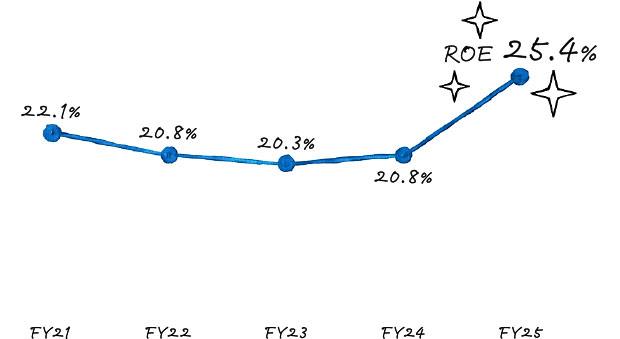
Furthermore, the commitment to returning the surplus capital generated in this way to shareholders is also embedded in HOYA’s DNA. Rather than accumulating excessive cash and cash equivalents, we continually refine our balance sheet through disciplined capital management. This approach has enabled HOYA to achieve a high level of capital efficiency, as reflected in its FY25 ROE of 25%.
Source of Strength 2
An Instinct for Choosing the Right Markets
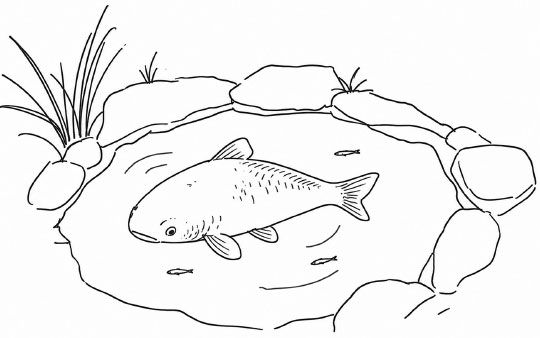
A consistent philosophy on market selection is fundamental to understanding HOYA’s growth strategy. It can best be summed up by our core principle: “a big fish in a small pond.”
HOYA does not enter markets crowded with competitors where success depends on engaging in head-on battles driven purely by scale and capital strength. Nor does it follow competitors into markets or regions simply because they are currently trending or experiencing rapid growth. HOYA believes that most competitive outcomes are determined at the very stage of market selection.
What matters is not the absolute size of the market.
HOYA targets markets that:
• Have exceptionally demanding customer performance requirements
• Require close technical collaboration and process alignment with customers
• Make it difficult for customers to switch suppliers once selected.
These are the kinds of markets in which HOYA can build deep, enduring relationships with its customers.
As a result, HOYA remains less exposed to price competition and can secure a dominant position without competing head-on against players whose primary advantage lies in scale.
The mask blanks business is an excellent example. Although it represents only a small segment of the overall semiconductor market, HOYA works closely with its customers on technology development and process alignment, creating an environment where second suppliers find it extremely difficult to gain a foothold.
Value in a given market can be expressed not only as Market Size × Market Share, but also as Market Structure × Customer Relationships. By placing greater emphasis on the latter, HOYA has consistently achieved stable, high profitability.
Source of Strength 3
A Business Structure That Is Difficult to Replicate
One question we are often asked by investors is whether competitors from emerging markets with lower-cost manufacturing capabilities could replicate HOYA’s business. Of course, that risk always exists. However, HOYA has mitigated the risk of losing market share by establishing its business structure itself as a strong barrier to entry.
Built on its expertise in optical technologies, HOYA has established a robust value chain that organically connects four essential elements:
(1) Materials Chemistry, (2) Core Technologies, (3) Mass Production Technologies, and (4) Commercialization
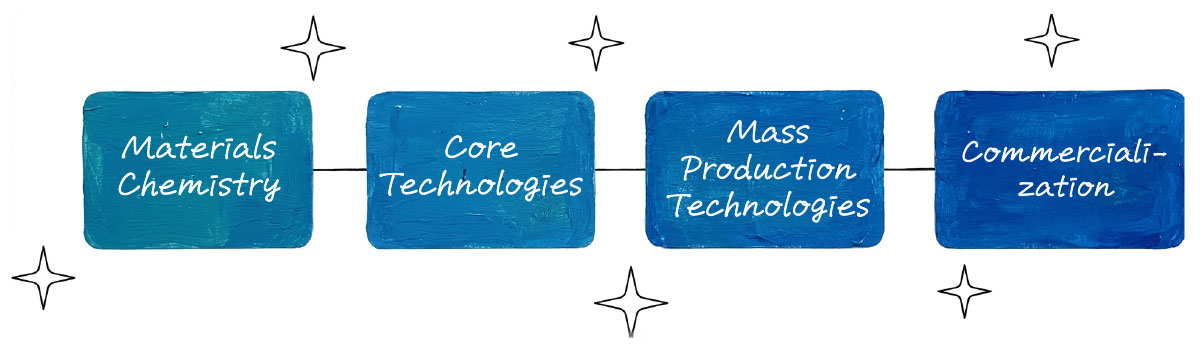
The relative importance of these four elements varies by product. For some products, materials chemistry provides the greatest barrier to entry, while for others it is the accumulated expertise in mass production. What matters, however, is not each element individually, but how they function together as an integrated whole.
For example, although multiple manufacturers once competed in the HDD glass substrate market, HOYA remained the sole dominant player by developing the expertise needed to maintain consistent quality while sustaining high-volume production.
Nor does HOYA rest on the success of its existing businesses. Through HOYA Incubation Laboratories (HILS), established in FY26, we are driving cross-divisional R&D and business development while taking a long-term approach to cultivating the next “small pond” for future growth.
HOYA is not a company that seeks attention through bold messaging.
Instead, HOYA has established a business model that quietly but consistently builds enterprise value through the combination of:
• High capital efficiency underpinned by financial discipline
• Disciplined market selection aligned with our proven winning strategy
• A value chain that is difficult to replicate.
Overcoming short-term environmental shifts to continuously generate sustainable long-term returns—this is the core appeal of HOYA as an investment.